Sunday, October 5, 2008

11. Sabu - Palo Congo (1957)


Tracks: El Cumbanchero//Billumba Palo Congo//Choferito Plena//Asabache//Simba//Rhapsodia del Maravilloso//Aggo Elegua//Tribilin Cantore

Review:

Voodoo! Freaky swampland shit! Witchdoctors crouched in the entrails of knackered goats chanting madly to evoke the gods of old Africa! Dead men hanging plague-addled from the trees as a yellow fire descends on the jungles of Haiti! The best rhythm section this side of Circadia swirling around itself like a Charley Chaplin drunk aching for a fight! New Yorker Sabu Martinez had played with some of the biggest names in Afro-Cuban music, and taken-over as conga player in Dizzy Gillespie’s band after Chanu Pazo got shot. This is the sound of a man at the fore-front of musical development in the mid-50s sitting down, looking around at the rock, jazz, and the Afro-Cuban up swell going on around him and thinking: “Where did it all come from?” And so he showed us.

Of course, that’s not strictly true. The stylistic innovations here are actually quite subtle and clever. Sabu Martinez has stripped Afro-Cuban-based music down to, well, Afro-Cuban folk music. And what’s the one core element of African music? The beat! There are drums, bass and guitar on this album, but the bass is largely unobtrusive, while the guitar is for the most part a snarling, distorted, chugging thing that sounds twenty years ahead of its time, standing grinning proudly right down in the guts of Latin rock. And when it’s clean, it forms spiralling arpeggios planted firmly mid-Atlantic. Over all this, everyone chants in a deeply syncopated style, with only the simplest melodies to be heard.

The genius of this is that Sabu then applies his virtuoso abilities in jazz percussion and his deep knowledge of Afro-Cuban music almost exclusively to the construction and deconstruction of grooves. This album is for the most part just one big, shifting mass of polyrhythm. This is, in a strange way, a jazz album (it was released on Blue Note, after all) – but with all the European elements stripped. And, from this primal framework, Sabu then proceeds to rather smart-arsedly cover Latin big band standard “El Cumbanchero”. It’s great! Going back to the start, and then working forward again with a fresh perspective. It probably helps that Martinez was recovering from a pretty bad heroin addiction at the time – this doesn’t sound like the work of a man in his right mind.

I should say, though, that even though this album is pretty marvellous (the guitar work, especially, is amazingly funky – it is god-damned funky!), not all the tracks are equal in their qualities. “El Cumbanchero” is pretty neat, benefiting from a catchy melody, but is a little thin and gets old quick. “Bilumba Palo Congo” is also just sort of... flaccid? Especially following the gruff, cackling vocal introduction that sets it up. It’s not bad, just not as good as the other songs on here. However, this speaks to wisdom on the part of whoever sequenced this – the other songs are all solid gold and as a consequence you grow more interested as the album progresses, rather than less so as is usual in a pop album with all the singles at the front.

I’ll also mention the production before I go. This album is mostly improvisational, and recorded live. This gives the entire thing a wonderfully echoed effect as the sounds bounce back from the walls of the recording space, which is magnified by the fact that the crowd, for some reason, sounds less like people than a distant, eerie wave jammed down in the back of the mix – another, bizarre component of the rhythm section.

And another thing – this album could not have worked in mono. It’s polyrhythm, man! Sabu and Co work absolute wonders by spacing the drums out across the two channels. It gives the grooves a very modern dimension and a whole other level of complexity. On the other hand, the intriguing production is kind of frustrating. You want to pump it on the stereo, but the complexity of the rhythms and the sheer sound of it kind of beg for headphones. In this way, I suppose this gives the album a nice extra layer of interest to keep you digging into what is, while fascinating, something of a one-trick pony.

So, yeah, this is great. Latin rock. African tribal chants. Proto-funk and Ur-trance. Even more laid-back forms of folk in the figure of “Rhapsodia del Maravilloso”, with its wonderful, sunny guitar work by Arsenio Rodriguez (see also: “Choferito Plena” for something a bit rougher). What more could you ask for? I will admit that I got my bongos out and tapped along – but damn it man, this is not an album to sit by and quietly nod at! The complexity of the thing is marvellous – the lack of any real central “One” beat means that there’s nothing – literally nothing – but syncopation and cross-rhythms. Thus, amazing grooves.

The album is also noteworthy, I suppose, in that it continues the fine tradition of naming jazz albums with elaborate puns. According to my research, “Palo” is a both a Cuban religion originating with the slaves, and a Spanish term meaning “type of music”. As a consequence, the album title “Palo Congo” means, if I’m not mistaken, both “Congo Style”, referring to both the Congo or sokous style of music and the place, and “Congolese Palo” in the religious sense. And add to this that “palo” also means “stick”! However, I should qualify all this with the fact that I don’t actually speak Spanish, and that at time of writing it is currently five in the morning and I have more coffee than blood in me.

So, damned fun. It’s just so unusual, especially for 1957. Bring on Tito Puente!

8/10

Download: Sabu Martinez - Choferito Plena Mp3

This is the last of the reviews written in the buffer period, so from this point forward things will be rolling day by day and in a perhaps somewhat more hallucinatory style.

Friday, October 3, 2008

10. Thelonius Monk – Brilliant Corners (1957)


Tracks: Brilliant Corners//Ba-Lue Bolivar Ba-Lues//Pannonica//I Surrender, Dear//Bemsha Swing

Review:

Ah! An excercise in contrasts! Rambling songs anchored by a single, atonal theme that is improvised on throughout the song. Sonny Rollins, Ernie Henry and Clark Terry on horn and Max Roach on drums. The madman with the hat and beard holds it all together with his demented, clanging pianos that would put Debussy’s teeth on edge. The first song contains a drum solo that sounds like a box full of pilates balls falling down a stairwell, clatters about the place like a room full of beetles and blowflies and then coalesces at the end into a simple but engaging groove. This one track took five takes to get right, and it still sounds like it’s about to fall apart at any moment. But Jesus! The cross-rhythms. There’s a drum kit and a bass there but it almost doesn’t matter – it SWINGS! It’s just the same section repeated half a dozen times at different speeds! It’s madness! Ornette Coleman was lurking just around the corner to take it all perhaps a little too far. Thurston Moore was clutched in is mother’s womb busily detuning his guitar. Bebop has arrived. This is it!

Well, no, Brilliant Corners didn’t invent bebop. I think maybe Charlie Parker did but I can’t remember. That’s pretty bad, that I can’t. Anyway it was about ten years old (though you wouldn’t know it, with all the swing on this list), and not really anything at all like this. This is hard-bop, whatever the hell that means. Anyway, stuff like “Brilliant Corners” is the reason I listen to music. Fifty years on, the track isn’t quite as immediately baffling as it once was. Now, it’s just sort of groovy. But dig in a little. Thelonious Monk was the first jazz artist I ever heard anything by. I listened to “Round Midnight” and “Straight, No Chaser” over and over again and tried with a complete lack of success to emulate the kind of complex rhythmical interplay present in his music. I couldn’t even play guitar – I couldn’t even tell if my guitar was in tune – and I was using Bitches Brew and Thelonious Monk as guiding lights of musical inspiration. I suppose, even at the start, I liked the weirder stuff. But still, a pretty stupid move.

You see, a lot of people listen to modern jazz and think “Ah! This is just noise! You can do whatever you want!” A lot of people read modern poetry and think the same thing. This leads to a lot of crap poetry, but thankfully playing jazz music requires a level of technical prowess which tends to vet a lot of enthusiastic but misguided amateurs. Hey! I’m not elitist. Beboppers were elitist. I say – if you can’t play jazz then grab a guitar and a copy of No Wave New York and see what happens.

I don’t pretend to understand “Brilliant Corners”. I understand “Ba-Lue Bolivar Ba-Lues”. It’s a blues composition, thirteen minutes long, riding a simple, easy structure and taking time out for each of the players to drop a technically-dazzling solo in between recitations of the theme. It's a relatively straightforward track and it's smooth as silk. The other tracks are, for various and individual reasons, just plain weird . The harmonic systems are completely out of sync with convention. I don’t understand on a technical level – I never bothered to learn much harmonic theory beyond some very simple stuff necessary to crank-out rock music. The notes lock together less on direct, one-two connections between each other, like you’d get on a 12 bar blues or a simple solo in a scale, than on the general sense of overlap between notes. I guess if it makes sense to say this, rather than being based around a root note the scales and keys are based around a point of absence which numerous notes abut. OK, so I’ve just made anyone with even a basic understanding of Western tonality very, very angry, but who cares. To put it simply – it’s all out of tune and Thelonious Monk doesn’t really seem to care.

The point of all this is that Brilliant Corners is utterly ramshackle, but holds together beautifully as a cohesive, harmonically balanced album. Thelonious wasn’t as radical as some of his contemporaries – the man wrote pretty melodies and hewed to comprehensible bop structures. This isn’t Sun Ra. Actually, why is there no Sun Ra on this list? Or Ornette Coleman? The only “free” stuff, really, is a bit of Miles Davis in Bitches Brew, which isn’t actually free, and John Zorn’s Spy vs Spy, which is kind of a cheat in that it combines No Wave with Ornette Coleman covers and thus gets the organisers of this list out of having to put too many “avant garde” releases on here. I mean, Brilliant Corners is a brilliant album (how many reviews have said that? I warrant, too many, but perhaps not enough), yet at the same time it’s thoroughly accessible. I have nothing against accessible music – I almost never listen to Ornette Coleman myself; but I do think that either one of his early albums (Free Jazz: A Collective Improvisation is both thoroughly accessible and massively important) or Eric Dolphy’s Out to Lunch would be very, very welcome additions Mr. 1001 Albums Big Cheese. Although I will grant that, never actually having read the book, they may in fact devote whole pages to singing the praises of Boredoms, the Contortions and, say, Alice Coltrane. And no, she’s not Free either.

Anyway. There’s nothing worse than a guy who doesn’t no what he’s talking about rambling about people not knowing what they’re talking about. Leave me alone! I’m sleep-deprived. It was this or a four thousand word essay on Feminism in 1950s middle-America that’s now worryingly overdue.

So, some of the other tracks? I wrote, only to have my computer crash, that “Bemsha Swing” shares more than a little in common with John Coltrane’s later “A Love Supreme” (or at least, I think so - it sounds damned like something I've heard before). The principal refrain, as well as the solos, all bear a suspicious resemblance. There’s nothing wrong with that, of course – it just serves further to highlight how good this is. Coltrane borrowed one small element from a shambolic 7-minute masterpiece of stormy dynamic interplay and marvellous rhythmic sax soloing (how the hell does... Ernie Henry I think navigate that ever-shifting beat?) and turned it into one of the most purely beautiful songs ever produced. This album is a watershed – it’s an Aladdin’s cave to be returned to again and again.

“Pannonica”, in contrast to “Bemsha Swing”, is a gentle number with swaying horns spelling out a delicate, shifting melody, a swinging rhythm on the drum and bass and a celeste of all things chiming out eerie accents. The song itself is relatively comprehensible, but the unusual combination of instruments gives it an added element which is utterly otherworldly. It’s simultaneously demented and enchanting, which sums the album up I suppose. Except that I still haven’t mentioned the classically-tinged solo piano piece, “I Surrender, Dear”. Tom Waits once said that Thelonious Monk once said that there are no wrong notes – only how you resolve them. You can hear that above all in this piece – he surveys the rough landscape of the song, plots a straight line to his destination and then clambers erratically about over hills and mountains to the conclusion. Yes, Thelonious Monk invented Parcour.

It’s a strange, fragmentary, angular style that’s quite captivating in its complexity, leaving no dynamic stone unturned. But it’s melodious. He fills-out the bare bones of melodies, or assembles their rough approximations out of scattered nots. This is Modernism, baby! This is cubism of the keys.

The name, to wrap up, is a thus a great and obvious pun. Monk takes a sudden dazzling turn, at the same time as he presents nothing but sharp angles. This is pointy music. It doesn’t seem quite as much, maybe, to modern ears, but back in 1957 this was baffling stuff. The careful, mathematical precision Monk brings to his compositions and playing is brilliant

This is a must-hear album. This is the sort of thing that makes you do some serious thinking. Also, it is a fun time for dancing. People forget that – that you can dance to modern jazz. That was actually one of the major things that pissed-off the Old School (Melle Mel was furious). Well. It’s not called the “Bemsha Swing” for nothing. I can only assume that "Bemsha" means "Stoned Revenant", but anyway. If you'll excuse me, I have a soul train to catch.

*duck-walks away into the distance*

9.5/10

Download: Thelonious Monk - Bemsha Swing [mp3]

Wednesday, October 1, 2008

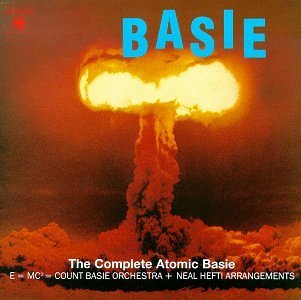
9. Count Basie Orchestra – The Atomic Mr. Basie (1957)


Tracks: The Kid from Red Bank//Duet//After Supper//Flight of the Foo Birds//Double-O//Teddy the Toad//Whirly-Bird//Midnite Blue//Splanky//Fantail//Li'l Darlin'

A violet-hot hydrogen bomb going thermal into the White Sands of your skull! Rattling the bones right out of your mouth to tap round the room with your erstwhile ego! If you will suck my soul, I will lick your funky emotions! Hang on, wait a minute – this isn’t be-bop. There are no hip neo-decadent Beats here. Why, it’s positively old-fashioned. Good lord, it’s SWING! Well, they don’t call it the Kansas City Stomp for nothing. Ever since I first read about Count Basie I always envisioned him as coming roaring out of the Mid-West like a steam train, thundering down into Harlem on the back of his band while the whole city started swinging to his piano. Animated cats were involved, and the Count had a red velvet cape and hair like Blacula. Of course, that’s not really an accurate description.

From what I gather, Basie toured hard and worked hard to get to the top, fighting his way up through Harlem clubs and gaining rep from a number of key gigs – such as his famous battle against Chick Webb the drumming dwarf that lasted all night and really lit his candle as a name to watch-out for. I don’t know much about the Count, as to be honest I’ve always preferred stuff post-bop. I do like Ellington, but as much because of his own compositions as because of the obvious debt owed to him by Charles Mingus, who is my absolute favourite band leader and the only one I know anything much about. But, from what I see here, I enjoy Basie quite a bit, and I might even dig into his catalogue.

Anyway, beside the point. Basie, like many others, suffered a massive career set-back after the war as the popularity of Big Band declined. Singers, now, were taking the stage. Guys like Frank Sinatra were putting the spot-light on the voice, whereas before the singer had just been another engaging element of any solid jazz ensemble. Basie wasn’t a composer, relying more on outside arrangers and freely-improvised “Head” compositions – tracks wherein the leader states a theme, and then the band grooves through it an elaborates basically on impulse. He played dance music, basically, and with the gradual death of live audiences for Swing there wasn’t much way for a live dance band, even a top-notch one, to survive. Ellington had composed pop and jazz standards and was able to survive off of them while in hibernation, but Basie didn’t have such a massive store of heavily licensed material to draw from given the freer approach he took to composition – although he made-up for this on an artistic level with a willingness to foster younger artists and with his dazzling instrumental technique.

So, as I understand it (as Wikipedia has given me to understand) his career took the up-and-up when he started to play to the times by attaching himself to big name singers. It makes sense – he’d had Billie Holiday as part of his live group back in the 40s, and a whole bunch of vocalists since. Then he got Neal Hefti in to do some arrangements (including this album), and things started going great-guns. He ended-up sliding out of life over the next few decades on the strength of his “Elder Statesman of Jazz” cache, as well as the generous tithes he received from his titled lands in Europe. After formally knighting Dizzie Gillespie at a sitting of Parliament in Birdland in late 1956, he declared himself accepting of bop and incorporated it into his music as a new and powerful weapon against the rise of rock-based voodoo cults. Unfortunately, he accidentally split the atom in the process – an event which led to the development of the first 100 megaton hydrogen warhead, thus escalating Cold War tensions to such a point that Eisenhower was forced to send Stalin every single poppy in Georgia as a way of apologising. Thankfully, this little-known but important historical incident can now be heard in hi-fidelity monophonic sound roughly 40 seconds into “Double-O” (Basie’s code name with the FBI). It is perhaps the first recorded instance of jazz fusion.

Or at least, so I’ve read.

So, what can you say about this album? Basie and his band swing hard. There’s a massive rhythm here – the bass is as high in the mix as it was ever likely to get in 1957. The drumming is phenomenal, although everything is strictly 4/4. Basie’s piano-playing is still rooted in pre-bop swing, and even quotes ragtime in the opening number, but he incorporates elements of bop everywhere – perhaps most obviously in the charming “Fantail”, but also in the dazzling displays of extremely rhythmic, hypnotic arpeggios that he brings out in “The Kid From Redbank”, for example. The band is huge and brassy and the riffs from the bank of horns are marvellous and enormous. And Basie’s roots in simple head compositions and free improvisation made him ideally suited for squaring himself with the bop crowd while still keeping to a swing format.

It’s not all big massive dance-floor anthems, however. The album is cannily structured like an actual concert, opening with perhaps the hardest, most foot-stomping number in “The Kid from Redbank”, and then dropping down into a few mellower, slow-dance and slove-jive numbers before mounting up into dizzying, but still (compared to the first track) relatively restrained “Flight of the Foo Birds”. And then “Double-O” hits, at first innocuous, but about a minute in it really does reach out and knock you right off your arse and on to the dance floor. This ebb and flow is maintained across the whole album, never less than danceable, closing out on the beautiful “Lil’ Darlin’”, which is utterly delicate and really rather lovely, with a gorgeous solo by someone whose name I can’t find. The album is full of great solos, actually, although none of them ever really grandstand and overwhelm the principle aim of the music, which is dancing. Dancing! Dancing! Dancing!

Put this album on anywhere and people will shake their arses off. It’s not a revolution in sound, but it does show both the roots of jazz, and the ways in which such jazz was moving forward and compromising at the time in a struggle to stay relevant in a world of radical formal innovation at a break-neck pace. So, at bottom it’s fun, it’s pretty, and it has a really apt cover. Hell, it manages to outswing Sinatra! And that guy loved swinging! He even named an album after it.

The downside of all this is, I suppose, that the tracks tend to all blend together. But then, isn’t that how you want it to be at a party? This is the same problem that faces Sinatra’s albums, I suppose – cohesive mood over the immediacy of individual tracks. It’s a problem common to a lot of Jazz, actually – not being pop music, it can often invest more interest in the playing than the composition. It’s a classic reason why a lot of people have a problem with bop, and would lead to massive divides in jazz listening public. But damn it, it works! The individual tracks are all nicely done in their own right. It’s just that individual segments within tracks hit harder than the songs themselves, thus lending I suppose to the feel of this as very much a “concert” performance. It doesn’t seem like the sort of thing I should be sitting down and listening carefully to, although it’s well-played and composed enough to warrant the attention given.

Speaking of details, I’ll just close-out on the production. This is one of the best-sounding records so far. The rhythm section is warm and thick but you can pick-out every detail. The horns come crashing over like waves. Ted Reig’s done a great job of capturing a joyous and beautiful recording.

I was really quite pleasantly surprised by this. I’ve never been a huge fan of Swing, or even, if we’re honest, of the other Basie stuff I’d heard. Here, however, he’s won me over. You may not remember much of it when you turn it off, but while your listening? It’s fun!

8/10


Download: Count Basie Orchestra - The Kid from Red Bank.mp3

Download: Count Basie Orchestra - Li'l Darlin'.mp3

8. Buddy Holly and the Crickets - The Chirping Crickets (1956)


Tracks: Oh Boy!//Not Fade Away//You've Got Love//Maybe Baby//It's Too Late//Tell Me How//That'll Be the Day//I'm Lookin' for Someone to Love//An Empty Cup (and a Broken Date)//Send Me Some Lovin'//Last Night//Rock Me My Baby

Well, as Police Chief Klein once said regarding the Ramones, "They're ugly, ugly people".

I should be honest and admit that I don’t think any rock album at this point is going to get full marks. The genre was still in its relative infancy! Furthermore, most rock albums at the time were just quickly-assembled packages of recent singles with b-sides and album cuts. Add to this the fact that bare-bones rock & roll has never exactly been my favourite genre, and you can see why I might not exactly go nuts over this stuff.

The “Chirping” Crickets does, however, present us with quite a lot worth going nuts over. Buddy Holly’s influence on the nature of rock is difficult to overstate. The only guy of comparable importance is Chuck Berry, and while the two guys do share a lot in common in terms of music (with Berry obviously having influenced Holly quite a bit), they’re still very different beasts. You listen to songs on this album and you can point and say – yes, this song invented The Beatles. Yes, the verses on “Rock Me Baby” more or less invented the Rolling Stones. Buddy Holly and the Crickets are like a framework onto which later acts have all laid their influences to create the wacky madness that is modern rock.

Having said that, it’s worth noting that Holly and Co clearly aren’t cooking this stuff up ex nihilo. The vocals on the rockers have a lot in common with early Elvis. “Not Fade Away” uses the Bo Diddley beat, and even cops the melody of his hit “Bo Diddley” for the vocal. “That’ll Be the Day”, probably the most famous song here, is in most respects just a swipe of Chuck Berry’s “Automobile”. However, Holly and the Crickets make it their own – they cut the blues groove out almost entirely and focus on the country and pop elements, turning it into a jerky rockabilly number which is in itself not really quite like anything else – there’s a nice little breakdown on guitar, and Holly’s vocals are very nicely done. At this point in rock music, these were big innovations - it was all about mixing shit together. Things went along slowly. Also, did you know that Holly was apparently inspired to write “That’ll Be the Day” by John Wayne’s catchphrase in the Searchers? Is it true? Who knows? Anyway, back to the music. “Not Fade Away” has great “boop bop bop” backing vocals and some nice chicken-pecking guitar work, and strips the skuzzy blues element out, once again, for a far more country-pop feel. Add to this the fact that Holly’s in fine voice throughout, and it’s a great song. The sense of rhythm these guys display is marvellous. They stirring all the harder guitar elements up with a wonderful fats Domino smoothness, and it’s great.

To focus more on the country element, however. Holly started-out singing bluegrass. Harmony is everywhere on this album – all though the “Chirping” Crickets never actually sing, every single song features the backing vocals of all-male group The Picks, who manage to sound entirely like women. “Tell Me How” is basically just a country song. The best rocker here is rockabilly, in the form of the amazing “Oh Boy”. Holly wrote many of the songs here, but not this one. Its hooks are amazing, and it’s the hardest thing on the list to this point. I’m constantly impressed with the amount of stuff that these bands managed to do with a simple 12-bar blues. It doesn’t hit as hard as a Little Richard number but it’s just as strong as a lot of his work in pop terms – almost all the force comes from the singing and the simple pound of the drums, but Jesus Christ! Holly growls and squeaks his way through the thing, riding on the drawn-out notes of the Picks and their doubling vocals. It manages to work gospel, country, blues and R&B into one song and I’ve had it stuck in my head for three days as of writing. And the lyrics! “All my life I’ve been waiting – tonight there’ll be no hesitating. When you’re with me, oh boy, then you’ll see that we were meant to be”. It’s some cheeky shit, I will grant, and a classic of the admittedly somewhat narrow-minded “Blue balls” school of rock. But hey! This is music for teenagers. Teenagers are horny devils. Replace “teenagers” with “people” and you have the vast majority of art, anyway. The difference is, the older tradition had been to play coy, whereas rock seems to have decided it might be better to simply go out grinning with prick held high.

Another great number is the more R&B “Maybe Baby”, with one of the coolest opening riffs going and a marvellous, hiccupy refrain. Holly did write this one, and it’s great. The guitar on the bridge is nothing but rattling madness. It’s followed by a ballad, “It’s Too Late”, which is a great crooning pop number. My favourite part is when Holly steps back from the mike to belt out the choruses and his voice develops a massive echo due to the added difference. After this is “Tell Me How”, a nice little pop ditty with lots of nonsense “la la la” singing from the Picks in the absolutely wonderful intro. The backing vocals are the catchiest thing here! La la la! And then the cymbal comes in on the bridge! Ah, it’s all wonderful and clops along beautifully. Holly’s vocal delivery here is marvellous, although the melody is suspiciously similar (although nowhere near as good as) “Peggy Sue”. His most obvious comparison here is to Roy Orbison (fair enough, as he co-wrote one of the songs here with him). It’s one of the weaker numbers here, but the vocal delivery and the amazing intro save it. This is a fine song, owing more to pop than anything,.

And that’s what really makes the album work, that it’s a pop album. Care is taken in the actual construction of most these songs – they have the nifty little introduction, an interesting middle 8 (check the dazzling little slithery guitar in “Looking For Someone to Love”). And the whole song is anchored by a catchy hook, and then a nice little finish. Most of these songs don’t even have a verse/chorus structure – it’s just a single repeating verse pattern and nothing but hook. Ah, it’s pop in essence and really quite wonderful. This stuff would be as influential on Phil Spector as it would on the Beatles or the Stones. The fact that these are rock songs being written by professional song-writers with long backgrounds in pop, who half the time are coming from outside the genre, are a great strength.

Having said that, there are one or two duds. Or at least, songs that aren’t as good as the more up-tempo stuff. “I’m Looking For Someone to Love” is better than half the rockers on Elvis’s debut, for example, but is still just a rather by-the-numbers piece of swing. “An Empty Cup (And A Broken Date)” is about as good as its title, which is to say “not very”. It’s just a rather ordinary ballad with a terrible backing vocal by the Picks. “Send Me Some Lovin’” is a bit better, but still not anything to write home about, although it does have a nice build in the middle. And unfortunately, all this means that the album starts to falter a bit on the second half. But then!

“Last Night” has a great, great hook, with Holly’s classiest vocal performance. It’s unquestionably the best ballad on the album, bobbing along over a “bum bum bum” vocal riff from the Picks and a simple four-note bass line. It’s beautiful. It’s delicate. I love this song. Quite strummed guitars! Ah, now this is a lovely pop song. The Picks unfortunately step-up to a lead vocal for the outro, but other than that it’s great.

The very last song, “Rock Me My Baby”, is half great and half just okay. The verses are god damned groovy. Unfortunately, the choruses are just sort of tedious Bill Haley fair. It even references Bill Haley in the lyrics! It’s not a bad way to close an album, I suppose, and it’s not a bad song. The all-over-the-place nature, combined with the fact that they actually manage to hold such a schizophrenic song together, lends it a lot of charm.

So, all in all not a bad album at all. There are a couple of shaky moments, but this is a fine, fine piece of work. Damn near everything from Fats Domino to Howlin’ Wolf Judy Garland finds its way into the album somehow, but it doesn’t sound disparate at all and as a consequence you don’t just have a bunch of different styles here – you have a genre! Early-60s rock is born! Bring on the Ronettes. Well, no, really they owe more to Fats Domino than anything. And to be fair the Beach Boys were ripping-off Chuck Berry songs, but anyway. It’s funny how the far more abrasive Berry ended-up influencing the Beach Boys.

This album is a fascinating testament to the varied people making it, and to their deep and differing life experiences. It’s a shame that Holly would die the following year, as he was both a fine, fine performer and an excellent songwriter in his own right. The number of ideas on display here are captivating, and the hooks! Such hooks!

Not a perfect album, but a really damned good one.

8.5/10

Download: Buddy Holly & the Crickets - Oh Boy.mp3
Download: Buddy Holly & the Crickets - Maybe Baby.mp3

7. Frank Sinatra - Songs for Swingin' Lovers (1956)


Tracks: You Make Me Feel So Young//It Happened in Monterey//You're Getting to Be a Habit with Me//You Brought a New Kind of Love to Me//Too Marvelous For Words//Old Devil Moon//Pennies from Heaven//Love is Here to Stay//I've Got You Under My Skin//I Thought About You//We'll Be Together Again//Makin' Whoopee//Swingin' Down the Lane//Anything Goes//How About You?

It’s something of a cliché, but tough guys do tend to be sentimental buggers. I suppose Sinatra epitomises this – he cast himself as something of a stand-offish loner, and as a consequence most of his songs were about broken hearts. It’s a perfect marketing move, of course. What’s more likely to appeal to the chicks than a rebel with a heart of gold?

And Sinatra certainly appealed to the chicks. Back in the 40s he was on top of his game as one of the first honest to goodness teen pop idols. Girls went wild for him! It was really rather unprecedented, and it made his name, but at the same time any career built around youth and sex appeal has a rather limited lifespan. So, as the Fifties loomed and Sinatra got older, his popularity began to wain. He left the stage in ’48, and returned in 1950 only to suffer a devastating haemorrhaging of the throat while performing live at the Copacabana. By 1952, his career was in tatters and Columbia had dropped him. It looked like the end.

Of course, it wasn’t. In 1955 Sinatra (“allegedly”) used his Mob connections to get the career-saving role in From Here to Eternity. He won an Oscar, he got onboard with Capitol, and he went back to being a superstar, recording some of the best albums of his career or anybody’s. Sensibly, however, he chose to revamp his persona, aiming at a more mature market with albums alternating between dark, introspective balladeering (see: In the Wee Small Hours; also the excellent Where Are You?, which shakes things up due to the switch to arranger Gordon Jenkins, who offers a slightly peppier and considerably lusher, more orchestral take on the ballad format), and up-beat swing albums like this.

Following In the Wee Small Hours with Songs for Swingin’ Lovers must constitute one of the most powerful one-two punches in the history of pop. The familiarity of both the material on this album and the innovative methods of arrangement that Riddle applied mean that some of the shine has worn-off, but you can’t really argue with the slinky woodwinds opening “I Thought About You”, or the steady build of “Anything Goes” from a slightly flaccid start as strings and horns pile up on one another into a single, monumental groove. This is actually an example of one of the most impressive aspects of this album. Everything grooves just fine, anchored by a strong rhythm section, but nothing about the beat is restrictive. Violins and horns swirl around each other and then descend on the drums for a particularly swinging section. Frank’s voice floats above it all with quiet assuredness. He manages to tighten the somewhat formless opening of “It Happened at Monterey” into something wonderful and sweeping by its end.

Managing to loosen-up and expand the sound of so many classic pop numbers, most of which were written originally for little more than a piano or a small jazz combo, is quite astonishing. And the jazz element is very strong here, despite this being a pop album dominated by strings. “We’ll Be Together Again” is a relatively subdued ballad, closing out on some brief, beautiful saxophone soloing, for example. And what can you say about “I’ve Got You Under My Skin”? The most famous recording here, it’s lighter than air at first, and then blooms into a big, brassy instrumental passage and some high, airy crooning from Frank. His phrasing is astonishing. He fits perfectly into the delicately constructed groove of the song, riding the changes effortlessly and never once overextending himself. His phrasing on the opening of “I Thought About You” kills me, and the refrain on “Swinging Down the Lane” is wonderfully infectious.

This is a difficult album to say anything new about. All the songs are at worst quite solid. The only real complaints I could make are that it’s perhaps a little lacking in variety (strings back everything, the same ensemble, it's all played recorded live in studio so there's no change in production), and consequently sounds overlong. This wouldn’t have been much a problem if I had to get up and change the sides over halfway through a party, but listening to it through on headphones the problem becomes apparent.

This is nitpicking, though. Apparently Sinatra once said about one of these Capitol records that the general idea was to put side one on at dinner with a partner, and by the end of side two you’d be right where you wanted to be. Given that this closes-out on “Anything Goes” and “How About You?”, that seems fair. Most of the songs are top-notch choices, but a few of them are just cheap sentiment. Sinatra transcends all this to create one hell of an aphrodisiac. There’s none of the gut-wrenching emotion of the In the Wee Small Hours, but would you really want to listen to anything that can be described as “gut-wrenching” during a nice evening alone in bed with your lover? Sinatra’s voice and Riddle’s truly beautiful music combine to systematically seduce the listener with wistful, silly little songs of loving. This is one of the other clear advantages of the 12” that Sinatra’s seized at – you can’t really make-out for any length of time to a 45, can you? Every aspect of anxiety and longing is covered in this collection, all enough to soothe anxious nerves and get you in the mood. One particular recurring lyrical theme is the idea of missing a great chance – it’s kind of coercive, maybe, but it works.

Of course, if there’s one complaint it’s the same that can be levelled at In the Wee Small Hours – even more so, actually. Namely, the music is quite stirring but it doesn’t always exactly demand attention. To Sinatra and Riddle’s credit, however, there is no filler. This is great stuff. The level of compositional complexity and excellence is something I really miss about a lot of older pop music. And it was innovative, too! Name a crooner who doesn't owe something to this? This sort of stuff has been around for so long that it’s very easy to forget that it was once new.

So, yeah, this is a pretty good album, though maybe not quite his best, if only because history has blunted its impact through overplaying and rip-offs.

8/10


Download: Frank Sinatra - I've Got You Under My Skin.mp3

Tuesday, September 30, 2008

6. Duke Ellington - Duke Ellington at Newport (1956)


CD 1: Star-Spangled Banner//Farmer Norman O'Connor introduces the Duke & Orchestra; Duke introduces Tune and Anderson, Jackson & Procope//Black and Tan Fantasy//Duke Introduces Cook & Tune//Tea for Two//Duke & Band leave stage; Father Norman O'Connor talks about the festival//Take the 'A' Train//Duke announces Strayhorn's & Nance; Duke introduces Festival Suite, Part I & Hamilton//Part I - Festival Junction (Live)//Duke announces soloists; introduces Part II (Live)//Part II - Blues to Be There (Live)// Duke announces Nance and Procope; introduces Part III (Live)//Part III - Newport Up (Live)//Duke announces Hamilton, Gonsalves, & Terry; Duke introduces Carny & Tune (Live)//Sophisticated Lady (Live)//Duke announces Grissom & Tune (Live)//Day In, Day Out (Live)//Duke introduces Tunes and Paul Gonsalves Interludes (Live)//Diminuendo in Blue and Crescendo in Blue (Live)//Announcements, Pandemonium (Live)//Pause

CD 2: Duke Introduces Johnny Hodges//I Got It Bad (and That Ain't Good)//Jeep's Blues//Duke calms crowd; introduces Nance and Tune//Tulip or Turnip//Riot Prevention//Skin Deep//Mood Indigo//Studio Concert//Father Norman O'Connor introduces Ellington; Ellington introduces New Work Part I//Part I - Festival Junction//Duke announces soloists; introduces Part II//Part II - Blues to Be There//Duke announces Nance and Procope; introduces Part III//Part III - Newport Up//Duke announces Hamilton, Gonsalves & Terry; Pause; Duke introduces Johnny Hodges; I Got It Bad (And That Ain't Good)// Jeep's Blues//Pause

Ellington’s career was more or less on the out in 1956. He was still good, and his band was still good – the new material debuted on this album shows that - but public interest simply wasn’t there. Two reasons are usually cited for this. On the one hand, big bands had been losing ground to individual singers since the 40s, until the point where they were more or less restricted to novelty acts. On the other, be-bop had hit, and jazz fans were being polarised to the point where the genre was becoming an intellectual rather than a popular pursuit. Complex, befuddling art may be great and all, but it seldom makes enough money to keep a touring unit of over twenty musicians in bread and board. Furthermore, Ellington was, let’s face it, a little out of his depth. His style of elaborately orchestrated, poppy composition had been groundbreaking and influential in its day, wasn’t the sort of thing that could be easily reconfigured into an Ornette Coleman track. His rhythm section couldn’t touch the fiery afro-Cuban grooves of Dizzy Gillespie. And after thirty years in the business, he maybe just didn’t have it in him to change it up. Isn't that the case? Obviously! Or:

The first half of this set doesn’t sound like a career-saving performance. It sounds like a very good performance by a band in top form, but not earth shattering. “Star Spangled Banner” is eerie and vaguely out of tune, and it’s the better for it. “Tea for Two” is modest but charming. After only two short tracks (one a rather unimpressive vocal) the band had to leave the stage due to missing personnel, but they came back later that night with a solid rendition if “Take the ‘A’ Train”, Duke’s signature tune as written by right-hand man Billy Strayhorn, who had returned to the fold after a brief stint as a solo artist and composer. Duke’s piano’s pretty decent here, I’ll admit, but the wonderful parping chorus is what really sells it.

“‘A’ Train” is followed by a wonderful three-part suite written especially for the festival. Ellington jokingly christens it “Festival Junction” on the spot. The first part is rather driving, opening with a strong theme pounded-out in chords on the piano. Then it swings into a lengthy, meandering section that eventually builds along some able support soloing up to a wonderful mournful solo on trumpet. This is thoroughly old-fashioned stuff, obviously – for a few moments at the start it looks like Duke is hinting at something more modern behind his piano, but then it slams straight into an old-time swing groove. The song closes out on a great trumpet solo right up into the mic as the backing drops-out, climbing up on a few ludicrous squeals to impressive heights.

The second part is far more subdued, coasting on a ride cymbal and some delicate syncopated piano work from Duke. “Blues to Be There” is appropriately almost more blues than jazz (again, incredibly old-fashioned) and it highlights the truth in Ellington’s reputation for refinement and sophistication. All in all, it’s very pretty, though more mood-oriented at first than immediately engaging. The clarinet work here is gorgeous. The backing drops out halfway for a brief scale, and then bam, back into the main theme on piano and some more New Orleans-style wah-wah trumpet, swaying into a beautiful swing section on the horns, consisting of little more than a few rising and falling notes. It’s at this point the band starts coming into its own, swinging into the rousing, up-tempo “Newport Up”, obviously geared with its brisk four-four towards a festival crowd. The trumpet tone here is very warm and tight, and quite lovely, but there’s not much to say aside from it being a very nicely done dance piece. The crowd reaction is enthusiastic, but modest.

“Sophisticated Lady” is all delicate reds and oranges and some lovely piano work – I do like the way Ellington cops so much from Debussy. It’s a charming rendition, complete with little stuttering horn riffs through the verse and a gently slide-out on the ride cymbal. Another vocal number follows, and it’s another modest success.

I suppose, if there’s been one problem up to this point it’s anyone who knows what’s coming. Up to this point, Ellington at Newport has been a very fine live document, easily up to many bands’ studio standards. With “Diminuendo in Blue and Crescendo in Blue” however, it leaps across to another level entirely. This is the famous bit – the solo by Paul Gonsalves that lasts a dizzying 27 choruses. Apparently they’d been experimenting with this for a while – the two halves of the song were always linked by a solo by Gonsalves, and the general idea was that he would just go out there and see what happened. This is the point where the night caught fire. The song dropped down to nothing but piano, bass and drums while Gonsalves carried the tune with his fine, simple soloing, until eventually everybody was crying out for him to keep it going like lunatics. It’s a strange moment that sort of creeps up on you. The solo starts, and it goes on for a bit, and then it just keeps on going, and the song become one long groove. The drums get heavier, accenting the rhythm with heavy crashes, and the piano starts pounding out a rudimentary groove before the song erupts into the brassy “Crescendo” (and Gonsalves presumably collapses of exhaustion). It’s a great deal of fun listening in on this moment. It’s a hell of a performance and enough alone to warrant getting this. The band put in everything they’ve got. Hell! It supposedly pulled a hot blonde in a cocktail dress from the crowd to start dancing, at a wimpy jazz concert in 1956. Listen to it loud.

Next up is “I Got It Bad (And That Ain’t Good)”, a fine number that Charles Mingus ripped-off for the “Alice” track from Mingus in Wonderland. It’s a showcase for Johnny Hodges on sax, and he does a great job. ‘Jeep’s Blues” is a big, brassy, swinging number with a great clarinet part. But even after this, the crowd didn’t want the set to end, and so we get “Tulip or Turnip”, which is a strong blues number and inarguably the best vocal performance on the album. The crowd hoot and holler through the whole thing, of course. They pile horns on horns and it’s a wonderful track. At this point they’ve largely ditched refinement and are going for the gut.

When this ended, the festival managers tried to shut the gig down. Ellington had Sam Woodyard play “Skin Deep”. This is, I’d argue, the absolute best track on here, and one of the most amazing drum tracks I’ve heard. It starts-out insane exotic horn stings and then turns into a thunderstorm of drums. Almost nothing but drums! Beautiful, amazing drums! If you know me, you know I love rhythm, and the one problem I have with Ellington on this album is his rather anaemic (at times) rhythm section. The moment where Woodyard’s double basses burst out from a series of random afro-Cuban patterings into an utterly heavenly syncopated groove is utterly breathtaking. And then it builds, at the end, to a crushing crescendo. It’s god damn beautiful.

I feel a little bad, on an album by such a man who was such a consummate composer and a generous band-leader, praising above all a really good drum solo. But, hey, that’s just how I roll. This whole album is damn solid, ranging from good to excellent. It’s damned long, but it never really feels it. When Ellington says goodbye, you’ll be howling no allowing with the folks in the audience on tape.

Of course, I haven’t even talked about the second disc. You see, having praised this album, there are now some rather knotty problems to untangle. Back in 1956, Ellington recorded this concert and then decided to release it as a live album, fair enough. But the recording quality wasn’t up to scratch. As a consequence, the band went into the studio following the festival and rerecorded sections of their performance to patch-up the holes. In the original recording, for example, you can’t even hear Gonsalves’ solo, since he played his trumpet into the wrong microphone. Well, that’s a problem, but only because a few years ago the folks at Columbia found a better quality recording of the night, one in which you can actually hear Gonsalves, and spliced it digitally with the original masters. As a consequence, we have here before us an excellent quality, stereo recording of the night – from a couple of years before stereo even debuted!.

The question is, which version do I review? I’ve already covered the live version, so that obviously predisposes my decision, but I will say a few words on the 1956 re-recording just to make sure that my reviews remain impossibly, tediously long.

We get a few pretty runs at “Festival Junction”, all of them greatly aided by being in the studio, and then we get the album proper, which consists of overdubbing audience noise and recreated stage banter onto the rerecorded set. The banter seems painfully stilted, and the album sounds like it was recorded in a concert hall rather than on a festival stage – although in the days before high fidelity stereo this may not have been a problem. We also lose “Diminuendo & Crescendo”, “Skin Deep” and “Tulip or Turnip” due to poor audio quality and the time constraints of the LP format. Other than that, though, it’s mostly the same album. It’s the same songs, anyway, and it’s still very fine. Large parts of the Festival suit have been re-done, but while the live versions are more energetic, the delicacy of “Blues to Be There”, for example, really shines on the studio cut. It’s easy to see why this, combined with the buzz generated by headlines regarding the ruckus at Newport, would reinvigorate interest in Ellington. This studio re-recording is an absolute gem – the performances argubaly better than the live version, if only because it captures approximately similar performances, but with far better recording quality and the tightness allowed by the studio environment. It’s wonderful! Christ, the soprano sax on “Newport Up”! The trumpet. You can harp about being genuine all you like – fraudulence gets results. The man was looking to salvage a career – would you risk a raw live cut or put everything you had into making yourself look like slickest bastard who ever tinkled an ivory? Everything hits harder! It just, you know, sounds better. As a studio recording should. And anyway, this is the album that’s been dazzling people for forty years.

So, it’s very hard to pick a favourite of the two, but in the end I’d argue that the original cut has the edge in polish, but the live recording matches it with energy, fascinating on-the-spot embellishments, and with the wider song selection, principally “America the Beautiful” and the two longer cuts missing from the LP. No matter how much nicer the studio versions sound, they can’t invalidate that drum solo and that amazing trumpet marathon. In any event, no matter how you cut it this is one of the best jazz albums I’ve ever heard. It was enough to bring a man back from the dead.

9/10

Download: Duke Ellington - Skin Deep.mp3

Monday, September 29, 2008

5. Fats Domino - This Is Fats (1956)


Tracks: Blueberry Hill//Honey Chile//What's the Reason//Blue Monday//So Long//La-La//Troubles of My Own//You Done Me Wrong//Reeling & Rocking//The Fat Man's Hop//Poor Me//Trust In Me


It’s a rock and roll album, but you wouldn’t really describe it as rockin'. This is a very laid-back and soulful affair. It’s more... cheery, than anything. The Barry White to Little Richard's Funkadelic. Fats Domino was one of the earlier pioneers of rock music, and it seems like by this album he still hadn’t got around to updating his style from the late 40s. This album is tacked together from singles recorded across the fifties, but remains stylistically extremely coherent nonetheless. All but one of the tracks is piano-led, most of them have a saxophone take the chorus. Honestly, it’s difficult to pick which tracks would have been recorded when just by listening.

So. That’s not necessarily a bad thing. Fats is doing something interesting here, and he does it well. He has a simple, relaxed style built-up around blues and pop with very strong gospel influences, and he marries that to a steady, gently swinging rock beat and lets the song carry itself on his pleasant crooning and distinctive, pulsing piano playing. “Blueberry Hill” is a fine example of this, very nice crooning R&B - an utterly lovelyl song, almost lighter than air. A few peppier numbers emerge to shake things up a bit, and he gets the horns out regularly to crank up the soul (although I suppose soul music as such didn’t really exist at this point – Fats and his ilk were busy creating it). Having said this, he does manage to work quite a bit of variety into what is a relatively restrictive format. “Reelin’ & Rockin’” stands-out the most from the crowd. The layers of horns and piano are stripped off and it rides a steady swinging beat, a proto-surf guitar and a tambourine that just won’t stop. It’s completely non-threatening, but it’s danceable and a lot of fun – I get the impression that a live show with Fats would have been pretty wild, but the records are for better part a family affair.

“The Fat Man’s Hop” is another stand-out – a straight-up blues instrumental, with the melody carried on the saxophone. “Trust In Me”, conversely, is a full-blown, honest to god rock & roll song. It’s got a repeating horn groove over which Fats croons, and an amazing display of folk-influenced electric guitar bubbling away like something from a Django Rheinhardt song over the top. It’s probably the only song that comes close to dropping the “restrained” qualifier from it, although to be fair standards were different back then and audio recording was not always at a great level. “What’s The Reason (I’m Not Pleasing You)” has an infectious little groove carried by slowly rising horn bends, and some funny little lyrics. In fact the lyrics on this album are all quite nice – there’s nothing earth shattering about them, but they’re often fairly funny. The choruses on “Blue Monday” build up to a modest crescendo on the strength of some nice stuttering drum breaks. It’s a pretty simple song about Mondayitis, but it’s not half bad. “So Long” is in a similar vein, but has a more delicate bridge carried by some beautiful saxophone playing.

There’s not much point going into depth with this album. You’d probably got a fair idea of what it sounds like. This is, blessedly, far more the antecedent of something like Stevie Wonder than Steven Tyler, you might say. Fats Domino was massively successful in his time, and there’s something so darn fun about the pleasant, positive music on this album that makes you see exactly why. Most of the songs aren’t immediately mind-blowing, but it has understated charm and a suitable danceability. The mix of R&B and rock is also a wonderful sign of things to come in the next decade - everything from the Shangri-Las to Sam Cooke to Curtis Mayfield and Nancy Sinatra. It's a goddamn blueprint for soul and R&B. And it’s great! Kids can make-out to it and grandparents can drink tea and talk about the war. Fun for the whole family.

I really like this. It’s... graceful.

8/10


Download: Fats Domino - Blueberry Hill.mp3